
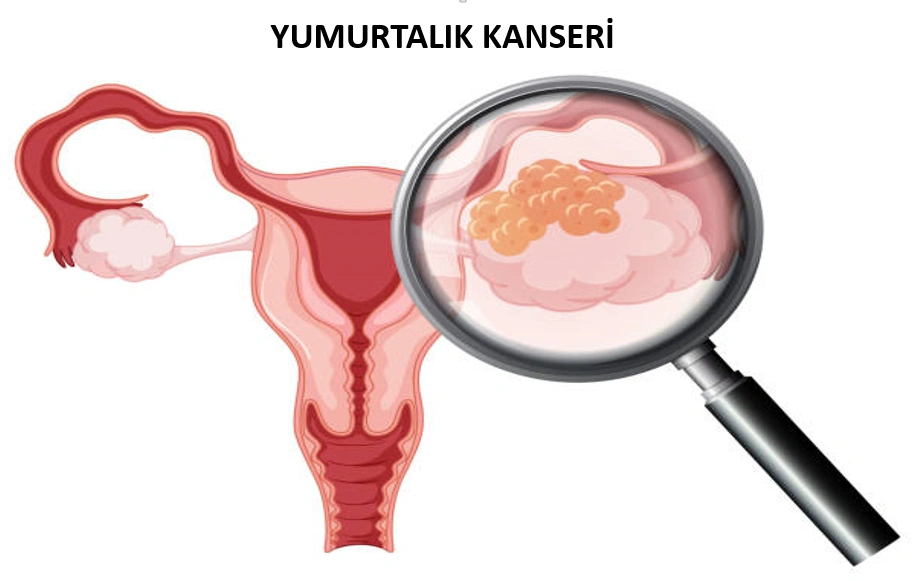
The ovaries, which are among the most important organs of the female reproductive system, are located in pairs adjacent to the uterus in the body. In addition to secreting crucial female hormones, the ovaries play a critical role in fertility by developing an egg each month.
Ovarian cancer develops from uncontrolled growth of cells within ovarian tissue. Treatment of this cancer usually requires surgery and chemotherapy.
Findings (Symptoms)
Ovarian cancer is silent and often does not present symptoms when it first develops. When it begins to cause complaints, the diagnosis is often delayed because the symptoms are usually mixed with those of other diseases. The following findings may be observed;
- Abdominal bloating
- Early satiety during meals
- Weight loss
- Discomfort in the pelvic region
- Fatigue
- Back pain
- Changes in bowel habits, often constipation
- Frequent urination
When Should You See a Doctor?
If the above findings have become persistent and worry you, I recommend making an appointment with your doctor. However, remember that regular gynecological examinations are the most sensible approach.
Causes
Mutations that develop in the DNA of cells residing in the ovaries cause healthy cells to transform into abnormal cells. Normal cells grow, multiply, and eventually die. Cancerous abnormal cells, however, grow, multiply uncontrollably, and become immortal. This abnormal cell population forms a mass called a tumor. Cancer cells can invade surrounding healthy tissue and can also spread to distant sites (metastasis).
Types of Ovarian Cancer
- Epithelial Ovarian Cancers: The most common types. Serous and mucinous ovarian cancers belong to this group.
- Stromal Ovarian Cancers: Rare. Detected at earlier stages than other ovarian cancers.
- Germ Cell Cancers: Rare. More often detected in younger women.
Risk Factors
- Advanced age: The incidence of ovarian cancer increases with age and is more common in older women.
- Inherited genetic alterations: A small portion of ovarian cancers develop due to genetic mutations passed from parents. These are the BRCA1 and BRCA2 genes. Women who carry these genes also have an increased risk of breast cancer.
- Family history of ovarian cancer: If women in your family have had ovarian cancer, your risk is increased.
- Obesity
- Post‑menopausal hormone replacement therapy: Synthetic hormones used to treat menopausal symptoms can increase the risk of ovarian cancer.
- Endometriosis: In endometriosis, tissue that lines the uterus implants in places it should not be, and the risk of ovarian cancer may rise.
- Long years of menstruation: Starting periods at an early age or entering menopause late.
- Never having been pregnant
Prevention
There is no method that provides 100% protection against ovarian cancer. However, some factors are known to reduce the risk.
- Using oral contraceptives: These pills provide a high degree of protection and also reduce the risk of ovarian cancer. Their side effects may make them unsuitable for some patients. You can discuss with your doctor whether oral contraceptives are appropriate for you.
- Discuss your personal risk factors with your doctor: If there are ovarian cancer patients in your family, you should share this with your doctor. In such cases you may be referred for genetic counseling. If genetic testing shows that you carry high‑risk gene mutations for ovarian cancer, surgical removal of the ovaries may be recommended before cancer develops.
Diagnosis
- Pelvic examination: Your doctor first inspects the external genital area (vulva). A special instrument called a speculum is placed inside the vagina to evaluate the vaginal canal and cervix (the neck of the uterus). Then, using two fingers inserted into the vagina, the doctor feels for any palpable mass in the vagina and cervix. Some structures that cannot be seen visually are easier to detect by touch. During the same procedure, the doctor presses on your abdomen with the other hand to compress the uterus and ovaries from both sides to determine whether an ovarian mass is present.
- Imaging tests: Ultrasound, CT, MRI and other imaging techniques can assess the structure of the ovaries. Transvaginal ultrasound is a gynecologist’s “hand‑in‑glove” tool and provides highly valuable information for evaluating the ovaries.
- Blood tests: Your doctor may order blood tests to assess your overall health and to evaluate tumor markers that can be elevated in ovarian cancer.
- Diagnostic laparoscopy: In some cases, to confirm the diagnosis, a small incision is made to insert a camera into the abdomen, allowing both imaging and collection of tissue and fluid samples.
- Genetic tests: Your doctor may request genetic testing to determine the presence of hereditary ovarian cancer. These tests can help plan your treatment and also assist in identifying risk factors for female relatives and daughters.
Treatment
The treatment of ovarian cancer is usually planned by combining surgery and chemotherapy. Different therapies may be added in specific situations.
Surgery
The primary goal of surgery is to remove cancerous tissue and to stage the cancer. The stage of the disease also determines the postoperative chemotherapy plan.
- Removal of one ovary: In early‑stage ovarian cancer, if there is no spread to other organs, only the affected ovary and its fallopian tube may be removed. This procedure preserves the patient’s fertility. The omentum (fatty tissue) and lymph nodes in the abdomen may also be removed.
- Removal of both ovaries: If cancer is present in both ovaries and there is no spread to other organs, the surgeon may remove both ovaries and their fallopian tubes. Because the uterus is preserved, the patient can still attempt pregnancy using her own frozen embryos, frozen eggs, or donor eggs. The omentum and abdominal lymph nodes may also be removed.
- Removal of the uterus and both ovaries: In patients who do not desire fertility, the uterus, ovaries, fallopian tubes, lymph nodes, and the omentum can be removed.
- Advanced‑stage cancer surgery: If the cancer is widespread within the abdomen, a challenging operation to remove all tumor‑laden tissue may be performed. Sometimes chemotherapy is given before surgery and the operation follows.
Chemotherapy
Chemotherapy uses special drugs that kill rapidly dividing cells. Cancer cells, because they divide quickly, are affected by chemotherapy. These drugs can be administered intravenously or orally.
Chemotherapy is often used after surgery to eradicate microscopic tumor cells that cannot be seen. In some cases it may also be given before surgery.
Summary
In cancer surgery, the right surgeon, the right technology, and the right pathology are essential. I strongly recommend researching your surgeon, obtaining opinions from patients they have previously operated on, asking about the technologies that will be used in your operation, and inquiring where and how the pathological examination will be performed.